Archaea and bacteria are both microorganisms. Archaea differ in the fact that their cell wall In fact archaea differ from bacteria as much as humans do in terms of.
Archaea General Microbiology
A prokaryote is a cellular organism that lacks an envelope-enclosed nucleus.

Bacteria and archaea differ in. They are similar in size and shape but differ greatly upon closer inspection of their genes and proteins. -is how archaea and bacteria differ. Types of molecules that distinguish bacteria and archaea.
However all archaea and bacteria are not prokaryotes. Archaea and Bacteria cannot survive in the same environment. The cell wall of Bacteria on the hand does have a mesh-like coating of peptidoglycan.
Both Archaea and Bacteria are unicellular organisms. All living organisms can be classified into 3 major domains. Archaea have cell walls that lack peptidoglycan and have membranes that enclose lipids with hydrocarbons rather than fatty acids.
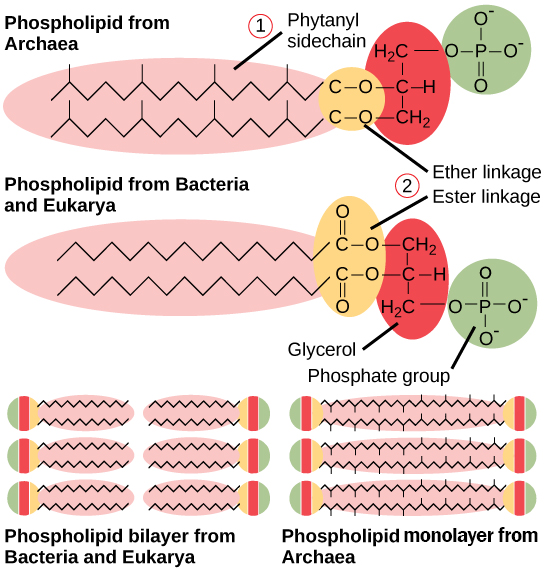
Archaea have unique phospholipids in their plasma membrane and hydrocarbon tails that contain isoprene. In the two-empire system arising from the work of Édouard Chatton prokaryotes were classified within the empire Prokaryota. The difference between Archaea and Bacteria is that the cell wall of Archaea does not have a polymer comprising of amino acids and sugars called peptidoglycan.
In the beginning archaea were classified as bacteria and was known as archaebacteria. WINDOWPANE is the live-streaming social network that turns your phone into a live broadcast camera for streaming to friends family followers or everyone. Archaea and Bacteria are two kinds of microorganisms that fall under the category of Prokaryotes.
The key difference between Bacteria and Archaea is that genes of Archaea are more similar to Eukarya than Bacteria. Core Differences between Bacteria and Archaea in Point Form Archaea reproduce asexually by budding fragmentation and binary fission while bacteria reproduce through the formation. Find out more in this lesson.
The reason for this was that both were similar in size and shape. Archaea have three RNA polymerases like eukaryotes but bacteria have only one. Bacteria have a unique compound called peptidoglycan in cell walls.
Archaea vs Eubacteria The difference between the Archaea and Eubacteria is that Archaea is a single-celled bacterium that thrives in extreme conditions while eubacteria live and thrive in normal conditions. Archaea do not use glycolysis. Archaea is the oldest bacteria ever known while the earth was formed.
The cell wall of the archaea contain Pseudopeptidoglycan while that of bacteria either Lipopolysaccharide or. Flagella act like bacterial flagella but structurally are different. One difference between archaea and bacteria can be seen in their cell structures where the latter contains peptidoglycan unlike the former.
Who trained the American troops. In this way they are different from eukaryotes which include both unicellular and multicellular organisms Archaea and bacterial cells lack organelles or other internal membrane-bound structures. Archaea are divided into different groups like Methanogens Thermophiles and Halophiles on the basis of their characteristics.
Likewise the bacteria archaea are single-cell simple prokaryotes lacking the well-defined nucleus and other organelles. Video Explaining the Differences. Both bacteria and archaea have different Ribosomal RNAs.
Types of molecules that distinguish bacteria and archaea. - by asexual reproduction called fission- no mitosis DNA strand duplicates and it is distributed to new cells. Similar to bacteria archaea do not have interior membranes but both have a cell wall and use flagella to swim.
Main Difference Bacteria and Archaea belong to the same family of micro-organisms called prokaryotes. But in the three-domain system based upon molecular analysis prokaryotes are. Archaea can live in environments with extreme conditions such as temperature while bacteria cant.
Similarities between Archaea and Bacteria. In addition Archaea do not have peptidoglycan in their cell walls while bacteria do. Differences between bacteria and archaea to process genetic info.
Bacteria are divided as Gram-negative and Gram-positive based on their response to Gram staining. Find out more in this lesson. Archaea and bacteria are both microorganisms.
They are similar in size and shape but differ greatly upon closer inspection of their genes and proteins. Archaea Bacteria and Eukarya. Key Difference Between Archaea and Bacteria Likewise the bacteria archaea are single-cell simple prokaryotes lacking the well-defined nucleus and other.
Bacteria can live. Archaea Bacteria and Eukarya. The cell wall of.
Both Archaea and Eubacteria belong to the kingdom called Monera. This is an example of a. Archaea and Bacteria share a number of features but are also distinct domains of life.
The word prokaryote comes from the Greek πρό pro before and κάρυον karyon nut or kernel. Earlier archaea were classified as bacteria but now it is outdated as it has been found that they both have different biochemistry and different evolutionary history. Archaea are found in the unusual environment like in hot spring ocean depth salt brines while bacteria are found.
Archaea differ in the fact that their cell wall does not contain peptidoglycan and cell membrane uses ether linked lipids as opposed to ester linked lipids in bacteria.
What Are The Differences Between Eubacteria And Archaebacteria Quora

Archaea Bacteria Similarities Differences Microbiology Class Video Study Com

A Comparison Of A Few Traits Of Bacteria Archaea And Eukarya Download Table

Archaea Bacteria Similarities Differences Microbiology Class Video Study Com

Archaea Vs Eubacteria Bioninja